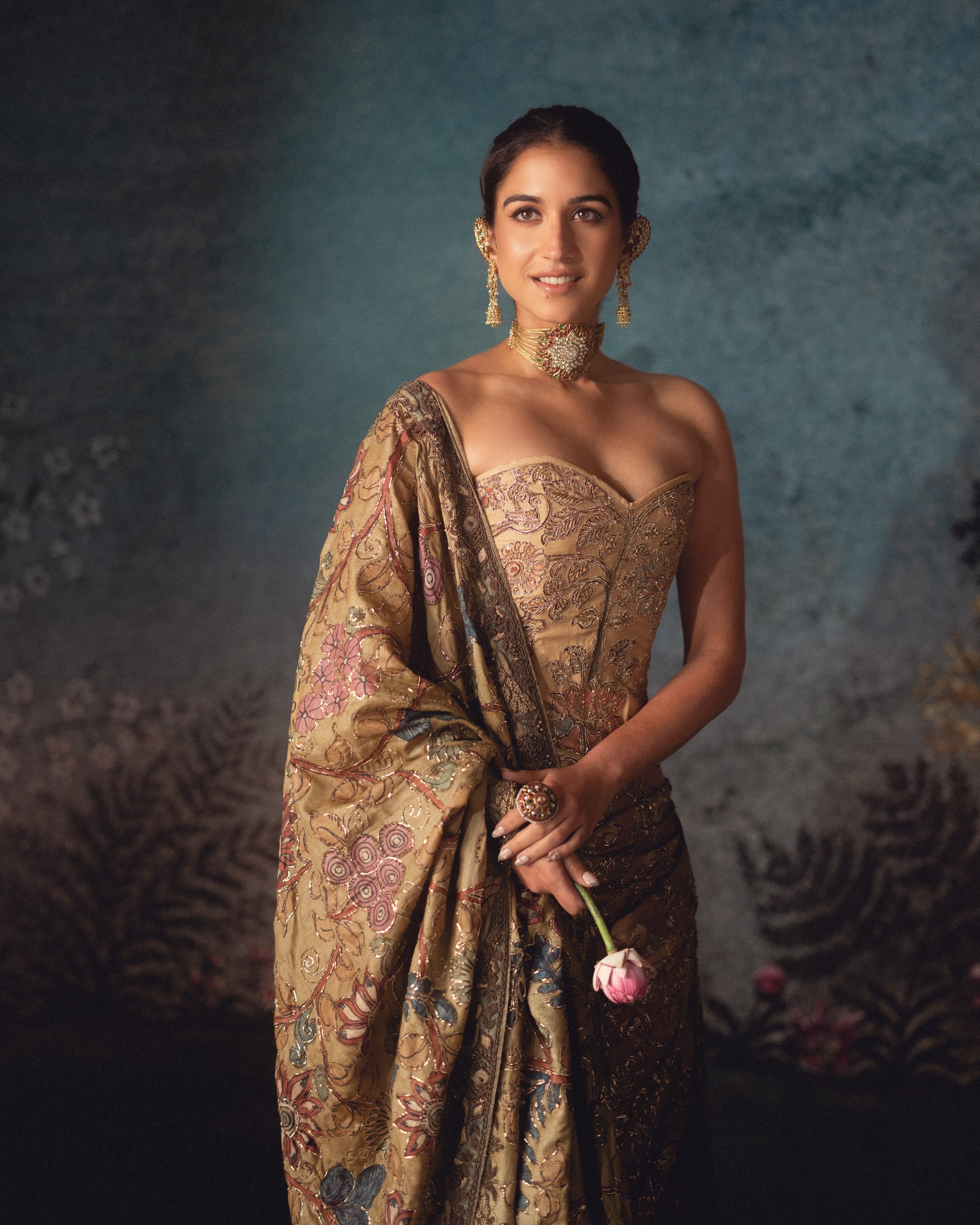
There is a particular electricity to a jewellery store opening, the glass newly polished, the trays reset, the lighting calibrated to make every facet behave. Sonam A. Kapoor chose that charged setting to reappear in public after what she called a postpartum sabbatical, arriving for “dearest Yash” at Birdhichand, in a look that made Birdhichand jewellery feel like family history rather than a flex.
Birdhichand jewellery, worn as a family narrative

Kapoor’s caption does the rare thing celebrity style posts often avoid, it names the stakes. She frames the relationship with Birdhichand as multi generational, “a relationship between our families that goes back two generations,” and ties it to a concrete moment, the opening of a “beautiful new store,” with a nod to seeing Yash’s father there. If you’ve followed Indian high jewellery for any length of time, Birdhichand needs little introduction, the Jaipur jeweller is longstanding, and the house is known for stones that do not rely on volume to announce themselves.
The styling credits read like a small fashion summit. Rhea Kapoor and Manisha Melwani are listed at the top, with a support team and dedicated draper, Shabnam Shaikh, which matters here because the jewellery is not floating in isolation. It is built into a whole surface of texture, threadwork, and craft that holds its own against gemstones.
Birdhichand maintains public information on the brand and its boutiques via its official channels, which is as close as one can get to a verifiable reference point from the post itself. See: Birdhichand official site.
Pichwai vocabulary, translated into hand embroidery
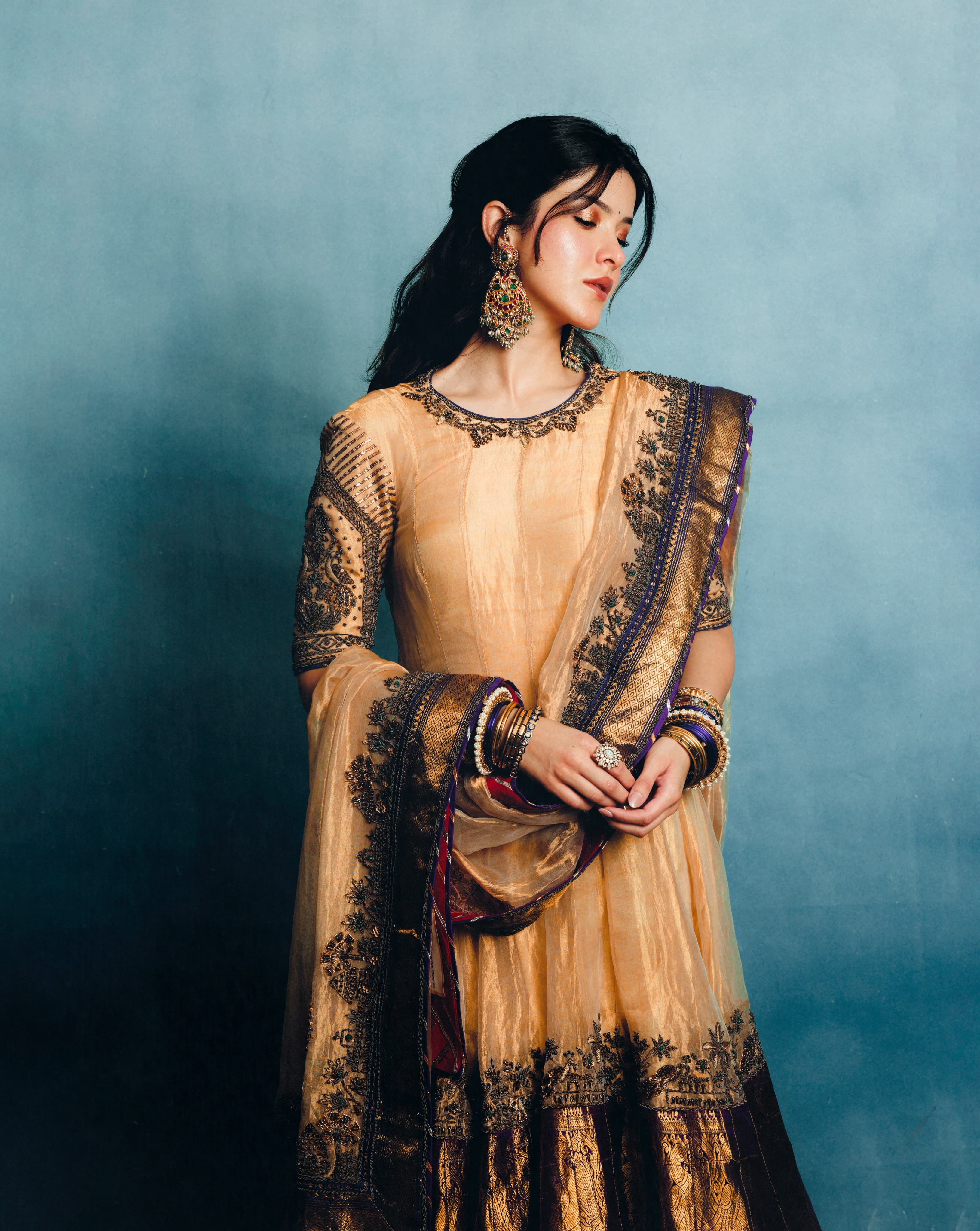
The clothes do not behave like a “jewels and a dress” afterthought. Kapoor describes a hand embroidered ensemble by Shanti Banaras and Raw Mango, a tussar georgette base, and a set of techniques that carry specific meanings in Indian textile craft: resham threadwork, and kasab tracing used to outline and emphasise motifs. She notes the imagery draws from Pichwai painting, a devotional visual tradition associated with Nathdwara, where Krishna is often pictured amid lotus ponds, cows, and dense botanical patterning.
What lands in photographs is a disciplined collision of surfaces. Georgette has its own fall and movement, tussar brings a dry, slightly irregular character to the weave, and hand embroidery changes the way fabric catches light by introducing tiny ridges and shadows. Against that, Birdhichand jewellery and matching accessories are not the only focal point, they have to compete with an entire illustrated field built in thread.
Raw Mango’s own channels have long been a useful framework for understanding how the label treats Indian textiles as contemporary clothing rather than costume, and it is the most direct source for the brand’s positioning and work. See: Raw Mango official site.

The backdrop mattered, and it was designed, not found
Even the setting is credited with the same specificity as the outfit. Kapoor points to doors designed by Agam Design Studio with Bhanu Prasad Melon, calling out marquetry as the defining element. Marquetry is slow work, veneer cut and set like puzzle pieces, and in a jewellery context it reads as a statement of intent: craft is not only what sits in the vitrines, it is also what frames the act of looking.
That attention to environment is what makes the new store feel less like retail theatre and more like an argument about continuity. When a brand opens a new space, it is often chasing footfall. When it commissions surfaces that demand close viewing, it is usually betting on time, the customer’s, the artisan’s, the brand’s.
Why this appearance resonated beyond a single look
Postpartum dressing is frequently discussed as a puzzle of practicality, but Kapoor’s return is more interesting as an editorial decision: a store opening for a jeweller with long roots, dressed in craft dense textiles, surrounded by design made the slow way. If you want to trace the through line, it sits neatly alongside contemporary Indian ceremony dressing that scales craft up to a public register, something we have explored in Fashion and in conversations about Indian maisons building modern heirlooms within Luxury.
In the end, the most telling detail is the one she offered without ornament, seeing Yash’s father. For all the optics of gems and marquetry, the occasion she marked was lineage, acknowledged in person.
Photo Credits
Cover image courtesy of Sonam A. Kapoor. Additional images courtesy of their respective owners.